


Table of Contents
- What an Acupressure Mat Does and Who It Suits
- How to Use an Acupressure Mat: A Beginner Progression
- How Long to Use an Acupressure Mat for Best Results
- What to Look For in the Best Acupressure Mat
- Getting the Most From Your Mat: Evidence, Value and Care
- Frequently Asked Questions
Last Updated: October 9, 2026
What an Acupressure Mat Does and Who It Suits
An acupressure mat is a therapeutic mat covered in thousands of small plastic spikes that press against pressure points across your back, neck and shoulders when you lie on it.
The principle is straightforward: your body weight does the work, and the spikes stimulate pressure points along the back. That stimulation is thought to encourage circulation and the release of endorphins, the body's natural feel-good chemicals.
How the Spikes and Plastic Discs Create Pressure
Each mat holds thousands of non-toxic plastic discs, and every disc carries a cluster of sharp spikes. When you lie down, your body weight pushes those spikes gently into the skin along the back, neck and shoulders.
That pressure is the whole mechanism. The intensity depends on how much of your weight rests on the mat and how long you stay there.
Who Gets the Most From Daily Use
Desk workers, teachers and busy parents tend to get the most from an acupressure mat. Anyone who holds tension in the neck and shoulders after long hours sitting, driving or carrying children will recognise the pattern. People exploring drug-free ways to unwind before bed also fit well.
If you have a diagnosed condition, check with a clinician first. More on that below.
How to Use an Acupressure Mat: A Beginner Progression
Start with a thin layer between you and the spikes, then build up over a week. That is the short version. Here is how we would do it.
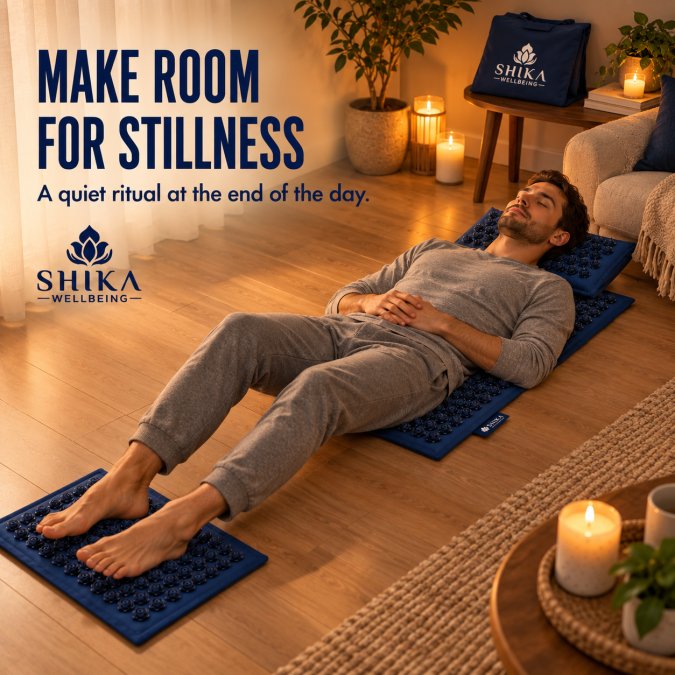
A woman in comfortable loungewear lying on an acupressure mat on a living room floor, eyes closed, with an ergonomic pillow supporting
Your First Week: Building Tolerance Step by Step
- Days 1-2: Lay the mat on the floor or bed. Wear a thin cotton t-shirt. Lie on your back for 5 minutes.
- Days 3-4: Remove the shirt if comfortable. Extend to 10 minutes. Add the acupressure pillow under your neck.
- Days 5-6: Try 15 minutes. Test the mat against bare skin on the lower back.
The tingling fades as your skin adapts. If it stings sharply, add a layer back and stay there a few more days.
How Long to Use an Acupressure Mat for Best Results
Twenty minutes is the sweet spot for most people. Sessions of 10 to 20 minutes, once or twice a day, are the common approach.
Acupressure Mat Risks, Side Effects and When to Stop
Acupressure mats are generally well tolerated, but they are not suitable for everyone. The most common side effects are temporary skin redness, mild soreness and light irritation where the spikes press. These usually settle within an hour or two.
Stop using the mat and speak to a clinician if you notice:
- Persistent or worsening pain
- Broken skin, bruising or a rash that does not fade
- Numbness or tingling that continues after you get up
Conditions That Need Medical Clearance First
Check with your GP or specialist before using an acupressure mat if you have any of the following:
- Pregnancy
- A bleeding disorder or you take blood-thinning medication
- Diabetes with reduced sensation in the feet or back
This is not an exhaustive list. If you are unsure, ask a healthcare professional first. Self-care should support professional care, never replace it.
What to Look For in the Best Acupressure Mat
Most buying guides list the same features: spike count, cover material, pillow included. That list is a starting point, not a decision. The harder question is how to compare two mats that look similar on a product page but perform very differently after six months of use. A useful framework weighs five things: usable surface area, spike geometry and evenness, core resilience, cover and hygiene, and the real cost of ownership over time.
Usable Surface Area and Shape
A mat only works where your body actually contacts it. A standard rectangular mat is typically around 68 cm x 42 cm, which covers most of an adult back but leaves the neck and shoulders to a separate pillow. Longer mats (often 120 cm or more) cover the full spine and neck in one piece, which suits taller users and anyone who wants to lie flat without repositioning.
Spike Geometry and Evenness
Spike count is a marketing number. What matters is whether the spikes are uniform in height and spacing, and whether the disc bases sit flat against the foam. A mat with over 5000 well-formed spikes gives consistent pressure; a cheap mat with uneven discs creates hot spots that feel sharp rather than stimulating. Run your palm across a mat before buying if you can, or check reviews for mentions of "uneven," "scratchy," or "hot spots." HIPS (high-impact polystyrene) is the common spike material because it holds shape without being brittle.
Core Resilience
The coconut core is what stops the spikes from collapsing under your weight. A denser core holds its shape for years; a soft core flattens within months and turns a once-comfortable mat into a lumpy one.
Cover, Hygiene and Cleaning
A removable, washable cover is not a luxury, it is the difference between a mat you can keep hygienic and one you replace. Look for cotton, linen, or a linen-cotton blend that can be machine washed at 30°C. Covers that are stitched in place cannot be cleaned properly and will absorb sweat and skin oils over time.
Our Premium Signature Acupressure Bundle uses non-toxic plastic discs, premium organic cotton and linen, and comes with a 5-year warranty. The Premium Acupressure Bundle offers over 7,000 sharp spikes in a linen-cotton blend with a subtle lavender pillow, and a 60-day trial period.


Getting the Most From Your Mat: Evidence, Value and Care
What the Evidence Actually Supports
Acupressure mats sit in an awkward evidence space. They are not medical devices, and most studies are small, short, and use different mats, durations, and outcome measures, which makes confident claims hard. The honest position is to grade claims by how much support they have, not to treat all benefits as equal.
- Relaxation and stress relief: The strongest support. The mechanism is plausible (pressure stimulation, a warm tingling sensation, and a forced pause) and user reports are consistent. This is the claim you can rely on most.
- Sleep and mood: Moderate, indirect support. Many users report falling asleep more easily after an evening session, but this is likely a routine effect as much as a spike effect. Treat it as a wind-down aid, not a treatment for insomnia.
- Muscle tension and general aches: Mixed support. Some users find real relief; others notice little. The effect is probably comparable to other relaxation tools rather than specific to acupressure.
Condition-Specific Safety Guidance
General precautions (redness, mild soreness) are not the same as contraindications. The distinction matters: a precaution means "start gently and monitor," while a contraindication means "do not use without medical advice." The following are situations where you should speak to a GP, specialist, or pharmacist before using a mat.
- Pregnancy: Avoid pressure on the abdomen and lower back, and check with your midwife or GP first. Acupressure points are traditionally avoided in some stages of pregnancy.
- Bleeding disorders or blood-thinning medication: The spikes can cause minor skin trauma; if clotting is impaired, even small breaks in the skin are a concern.
- Diabetes with reduced sensation: If you cannot feel pressure or pain accurately in the back or feet, you may not notice skin damage until it is significant.
This list is not exhaustive. If you are unsure, ask a healthcare professional. Self-care should support professional care, never replace it.
Cleaning, Storage, and Product Lifespan
How you care for a mat determines how long it stays comfortable and hygienic. The spikes trap sweat, skin cells, and dust, and a mat that is never cleaned will smell and lose its appeal long before the foam fails.
Wipe the spikes with a damp cloth and mild soap, if necessary or use a water-based wipe. Avoid alcohol-based cleaners, which can degrade some plastics.
With good care, a quality mat with a dense core and removable cover should hold its shape for several years. A cheap mat with a soft core and stitched cover may need replacing within a year. Shika Acupressure Mat has a 5 year warranty.
Accessibility and Body-Specific Adaptations
Not everyone can lie on a mat, and that does not mean missing out. Practical adaptations include:
- Chair-based use: Place the mat on a chair back or seat for neck, shoulder, or lower-back contact while sitting.
- Partial contact: Use the mat under the feet, calves, or hands rather than the full back.
- Layered pressure: Start with a thick towel or blanket between you and the spikes, then reduce layers as tolerance builds.
For a complete evening ritual, the Signature Sleep Well Acupressure Bundle pairs the mat with a lavender aromatherapy set, and the Pure Silver-Plated Acupressure Ring is a pocket-sized tool for tension in the hands.

Signature Sleep Well Acupressure Bundle
Frequently Asked Questions
Do acupressure mats actually work?
Evidence is strongest for relaxation and short-term comfort rather than cure. Small studies suggest lying on the spikes may ease muscle tension and support a calmer wind-down routine, though clinical research is limited and mixed. Many users report feeling looser and more relaxed after 10 to 20 minutes. Treat an acupressure mat as a complementary tool alongside, not instead of, appropriate healthcare.
How long should you lie on an acupressure mat?
Start with 5 to 10 minutes on a thin layer of clothing, then build towards 20 minutes as your skin adjusts. The Premium Acupressure Bundle for stress and tension relief is designed for a 10-minute session that users describe as relaxing. Daily use is fine once you are comfortable, but stop sooner if you feel sharp pain rather than firm pressure.
What are the potential downsides of using an acupressure mats?
Common side effects include temporary skin irritation, redness and sensitivity where the spikes press, plus mild soreness for a day or two in beginners. People with bleeding disorders, anticoagulant medication, open wounds, recent surgery or certain skin conditions should check with a GP first. Stop immediately if you feel numbness, dizziness or pain that does not settle.
Can an acupressure mat help with back pain?
Some users with lower back pain, sciatica or neck tension report relief after regular sessions, and the ergonomic pillow in a mat set targets the neck and shoulders specifically. Evidence is not conclusive, so results vary. If pain is persistent, worsening or linked to a diagnosed condition, speak to a healthcare professional before relying on a mat as your main approach.
How do you use an acupressure mat for the first time?
Lay the mat flat on a firm surface, wear a thin cotton top, and lower yourself on slowly rather than dropping down. Begin with 5 minutes on your back, breathing steadily, then roll gently to one side to get up. The Shika Premium Signature Acupressure Bundle includes two ergonomic pillows to support the neck and shoulders during those first sessions.
Can you use an acupressure mat every day?
Yes, daily use is generally fine for healthy adults once your skin has adapted to the spikes. Many people build a routine of 10 to 20 minutes in the evening as part of a wind-down before bed. Rotate positions between back, neck and legs so the same area is not over-stimulated, and skip a day if skin feels tender.
Who should avoid using an acupressure mat?
Avoid it if you are pregnant, have a bleeding disorder, take blood-thinning medication, have recent surgery, fractures, open wounds, severe skin conditions or uncontrolled high blood pressure. Anyone with a chronic pain condition should get medical clearance first. The 60-day trial and 5-year manufacturer's warranty on Shika mats let you test comfort before committing.
What should I look for in the best acupressure mat?
Prioritise spike density and firmness, non-toxic HIPS plastic discs, a natural cotton or linen cover, and a foam filling that holds its shape. An ergonomic pillow and travel bag add value, as does a clear warranty. The Shika Signature Sleep Well Bundle at £149.99 pairs a mat and pillow with aromatherapy sleep tools for a fuller wind-down routine.
Long working days and family commitments leave little room for rest, and that is exactly when a simple ritual helps most. Shika Wellbeing UK builds nurse-developed acupressure mats with certified non-toxic spikes, premium organic cotton and linen covers, and a 5-year warranty, so you can create a calming home spa moment in 20 minutes. Explore our UK online wellness shop and make relaxation part of everyday life.
Share:
Why I Created the Shika Wellbeing Acupressure Mat & Pillow Set: A Simple Wellness Ritual for Busy Professionals